There was a time when the sky had voices.
Before the crowns of men, before the stone roads, before the banners of kingdoms were raised over the valleys and highlands of Dragonheim, the dragons ruled no throne and answered to no king. They were older than law, older than written speech, and older than the borders that now divide the realm. To some, they were gods. To others, they were the first children of creation. To the boldest and most foolish, they were beasts to be hunted.
The truth has been buried beneath centuries of ash, bone, and royal lies.
The world remembers only fragments.
It remembers wings blotting out the sun.
It remembers mountains split by fire.
It remembers rivers boiling in their beds.
It remembers armies kneeling in fields of glass.
It remembers kings lowering their crowns before shadows greater than any throne.
It remembers the final roar, heard from one end of the realm to the other, when the last dragon was said to have fallen.
That age is now called the Ashen Silence.
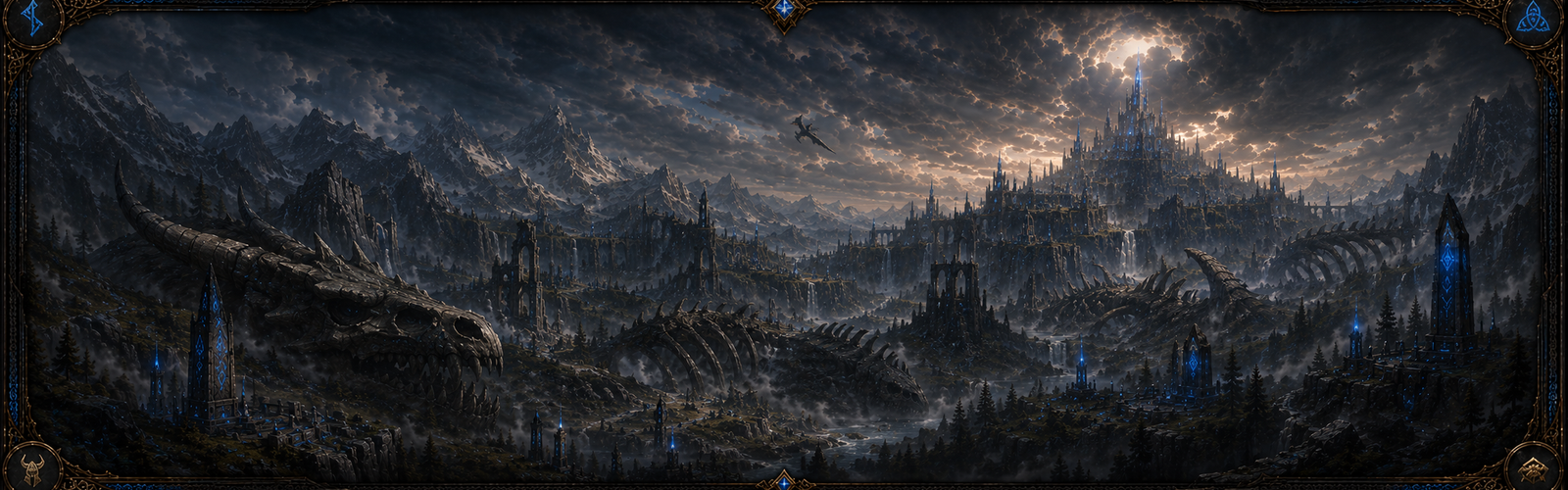
No living man has seen a dragon. No queen has heard one speak. No child has watched one pass over the moon. The great beasts are believed extinct, their bones scattered beneath battlefields, sealed in catacombs, mounted in royal halls, or ground into relics by those who claim power from their deaths.
Yet Dragonheim was not freed by the death of dragons.
It was built upon it.
The kingdoms rose from the ruins of their passing. Noble houses forged their legends from ancient hunts, sacred oaths, and victories that grow grander with every retelling. Some claim their bloodlines were blessed by dragons. Others claim their ancestors slew them. Some display dragonbone above their thrones, while others hide their relics deep below stone keeps and sealed chapels.
In Dragonheim, power is rarely separated from the dead.
Kings wear dragonbone at their coronations and call it proof of divine right. Priests burn incense over ancient scales and name the smoke holy. Scholars study old claw-marks carved into mountain stone and argue whether they were warnings, prayers, or laws. Dragon-hunter houses preserve their old banners, though none have hunted a true dragon in centuries. Merchants sell fragments of bone, ash, tooth, and scale to anyone rich enough to believe that power can be purchased.
But not all relics are false.
Not all graves are empty.
And not all stories are lies.